https://www.acsysteme.com/wp-content/uploads/2026/04/couv_robot_transport_interface-e1777455162264-750x592.png

Our cars are robots

Automation is emerging as one of the cornerstones of future mobility. As cars become increasingly autonomous, they are getting safer and more comfortable, and a new business model is opening up for manufacturers.

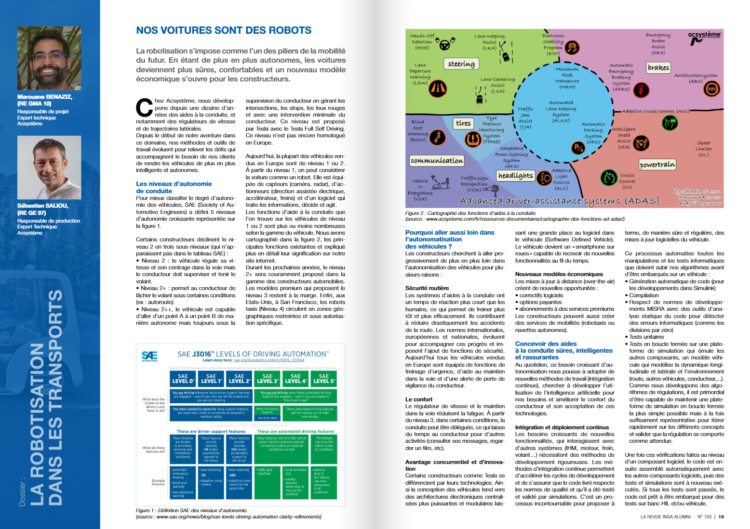
In the magazine Interface, published by INSA Alumni (Institut National des Sciences Appliquées), Marouane Benaziz (Class of RE GMA 10) and Sébastien Saliou (Class of RE GE 97) co-authored an article on the automation of transportation.

https://www.acsysteme.com/wp-content/uploads/2026/04/Interface_article-750×529.png
Photo de l'article d'Interface

Article “Our Cars Are Robots” on Interface magazine

Link to Interface #115

At Acsystème, we have been developing driver assistance systems for the past decade, including cruise control and lane-keeping systems.

Since we first ventured into this field, our methods and tools have evolved to meet the challenges posed by our customers’ need to make vehicles increasingly intelligent and autonomous.

Levels of autonomous driving

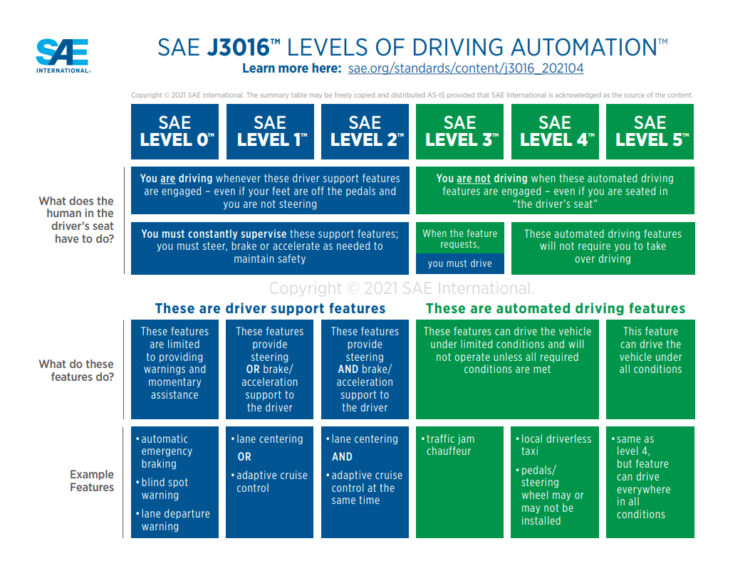
To better classify the degree of vehicle autonomy, the SAE (Society of Automotive Engineers) has defined five levels of increasing autonomy, as shown in the figure below.

https://www.acsysteme.com/wp-content/uploads/2026/04/SAE-750×578.png

Levels of driving automation

Some manufacturers divide Level 2 into three sub-levels (which do not appear in the SAE table):

  • Level 2: The vehicle controls its speed and keeps itself centered in the lane, but the driver must monitor the vehicle and keep their hands on the steering wheel.
  • Level 2+: Allows the driver to take their hands off the steering wheel under certain conditions (e.g., on the highway).
  • Level 2++: The vehicle is capable of traveling from point A to point B autonomously but always under the driver’s supervision, handling intersections, stop signs, and traffic lights with minimal driver intervention. This level is offered by Tesla with Tesla Full Self-Driving and is not yet approved in Europe.

Today, most vehicles sold in Europe are Level 1 or 2. Starting at Level 1, the car can be considered a robot. It is equipped with sensors (camera, radar), actuators (electric power steering, accelerator, brakes), and software that processes information, makes decisions, and takes action.
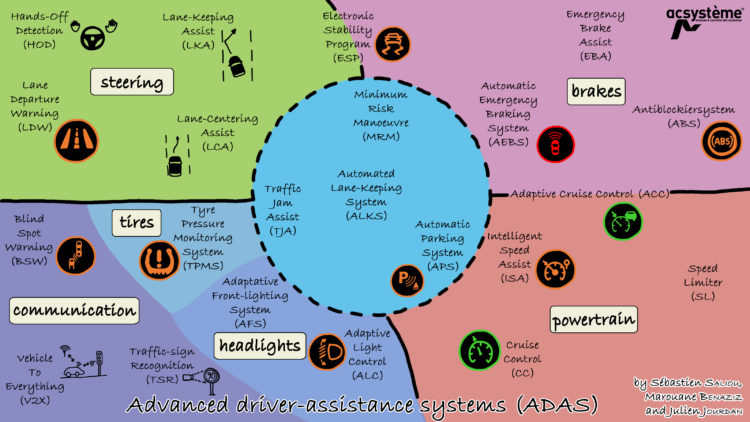
The number of driver-assistance features found on Level 1 or 2 vehicles varies depending on the vehicle model. We have mapped out the main existing features and explained their significance in more detail in this article.

https://www.acsysteme.com/wp-content/uploads/2024/05/cartographie-fonctions-AD-ADAS-2024-Acsysteme-750×422.jpg

Mapping of driver assistance features by Acsystème

Link to the article

Over the next few years, Level 2+ will become a common feature in car manufacturers’ lineups. Premium models offering Level 3 remain a niche offering. Finally, in San Francisco, U.S., robotaxis (Level 4) operate in restricted areas and require specific authorization.

Why go to such lenghts to make vehicles autonomous?

Automobile manufacturers are seeking to gradually push the boundaries of vehicle autonomy for several reasons

Road Safety

Driver-assistance systems have a shorter reaction time than humans, allowing for earlier and more effective braking. They help drastically reduce traffic accidents. International, European, and national standards are evolving to keep pace with these advancements and require the inclusion of safety features. Today, all vehicles sold in Europe are equipped with emergency braking, lane-keeping assist, and driver attention warning systems.

Comfort

Cruise control and lane-keeping assist reduce driver fatigue. Starting at Level 3, under certain conditions, driving can be automated, giving the driver time for other activities (checking messages, watching a movie, etc.).

Competitive and Innovation Advantage

Some manufacturers, such as Tesla, set themselves apart through their technologies. As a result, vehicle design is moving toward more powerful and modular centralized electronic architectures, giving software a prominent role in the vehicle (Software-Defined Vehicle). The vehicle is becoming a “smartphone on wheels” capable of receiving new features over time.

New Business Models

Over-the-air updates create new opportunities:

  • software patches,
  • paid options,
  • subscriptions to premium services.

Manufacturers can also create mobility services (robotaxis or autonomous shuttles).

Designing safe, smart, and reassuring driver-assistance systems

On a daily basis, this growing need for autonomy drives us to adopt new working methods (continuous integration), explore ways to leverage artificial intelligence for our needs, and enhance driver comfort and acceptance of these technologies.

Continuous integration and deployment

The growing need for new features that interact with other systems (HMI, engine, brakes, steering wheel, etc.) requires development methods that ensure the delivered code meets quality standards and has been tested and validated through simulations. This is an essential process for ultimately providing vehicle software updates safely and regularly.

This process automates all the data processing and computer testing that our algorithms must undergo before being deployed in a vehicle:

  • Automatic code generation (for Simulink development)
  • Compilation
  • Compliance with MISRA development standards using static code analysis tools to detect programming errors (such as division by zero)
  • Unit testing
  • Closed-loop testing on a simulation platform that emulates other components, a vehicle model that simulates longitudinal and lateral dynamics, and the environment (road, other vehicles, driver, etc.). Since we are dealing with control algorithms, it is essential to maintain a closed-loop simulation platform that is as simple as possible yet sufficiently representative to quickly iterate through different concepts and verify that the control system behaves as expected.

Once these checks have been performed at the software component level, the code is then automatically integrated with the other software components, and tests and simulations are run again. If all tests are passed, the code is ready to be deployed for HIL bench and/or vehicle testing.

In practical terms, once a developer has finished developing a feature or fixed a bug, the process automatically performs all the checks mentioned above and delivers code that is ready to be installed in a vehicle.

The Rise of AI in the Automotive Industry

Sensor technologies (cameras, radar, lidar) and computing capabilities are evolving rapidly, enabling the management of increasingly complex use cases. To handle such situations, the use of AI appears to be crucial.
Machine learning is now commonly used to process images from cameras to recognize lane markings and obstacles. However, its use in path planning and vehicle control remains limited in the industry, where rule-based approaches—based on explicit rules—still dominate. Nevertheless, given the complexity of real-world situations we aim to manage (such as navigating an intersection, for example), this approach is reaching its limits.

The alternative to rule-based systems is the use of machine learning algorithms. Some propose extreme “End-to-End AI” approaches that involve setting up a neural network that takes sensor and location data as input and outputs commands for steering, the engine, and the brakes. The advantage is that there is no longer any hand-written code; however, these approaches raise questions regarding formal validation and a certain lack of transparency in the event of a problem. Furthermore, these models require millions of kilometers for training and validation. Consequently, the prevailing trend is toward a hybrid approach that combines rule-based control with machine learning for certain planning and supervision functions.

The challenge of user acceptance.

Even the best technologies will only be useful if users trust them. Unfortunately, many drivers today disable driver-assistance features because they find them too intrusive. With Level 1 or 2 driver-assistance systems, the key feature is that the car is controlled by two entities: the driver and the driver-assistance system. The main goal is therefore to achieve harmony between the driver and the system. The system must be able to reassure the driver, perform maneuvers, or assist them when necessary, but without being too intrusive. Sharing control between the system and the driver is a complex issue we are working on.

Our cars are already robots capable of performing certain tasks autonomously. The favorable regulatory framework and technological advancements are opening the door for us to design and develop the algorithms that will make them even safer, more autonomous, and scalable.

Marouane Benaziz & Sébastien Saliou, april 2026

Share this post: