https://www.acsysteme.com/wp-content/uploads/2025/12/illustration-modele-simulation-pompe-vide-atelier-dimensionnement-750x414.png

Sizing an indsutrial installation using modelling

In the field of industrial vacuum, choosing the right combination of pumps for a given installation to achieve the desired performance (vacuum level and pressure drop rate) is not based solely on nominal characteristics.

It depends heavily on the nature of the gas and the configuration of the installation: chamber volume, pipe length and geometry, pressure drops, and, of course, the type of pumps used. Simulation becomes a strategic tool for taking all these parameters into account. 

A model-based sizing workshop

It was in this context that we assisted a pump manufacturer in developing a modelling and simulation environment used by engineers and sales representatives as a workshop for sizing vacuum systems. The objective was threefold: to enable engineers to develop their modelling skills, to simulate the dynamic behaviour of a complete installation, and to evaluate the performance of different pump configurations (achievable vacuum level, pressure drop time, etc.).

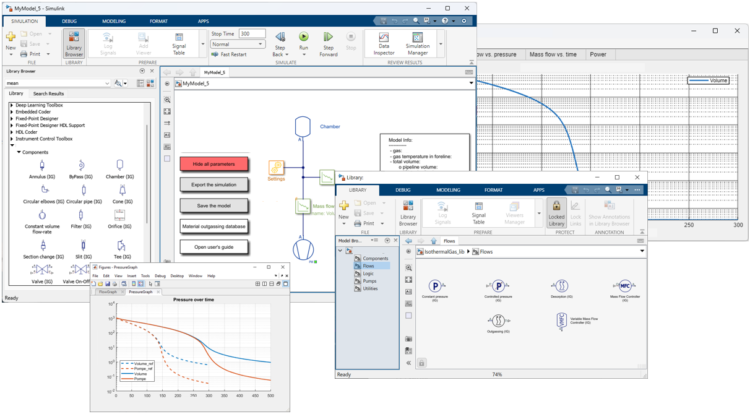
The sizing workshop includes a library of mathematical models specific to the vacuum pump industry. These models take the form of customised blocks in Simulink and Simscape, representing the physical components of the system: chambers, pipes, elbows, valves, and of course, the various pimp technologies available in the catalogue. Each block encapsulates the relevant physical equations (conservations laws, pressure losses, pumping characteristics) and can be configured according to actual technical data.

https://www.acsysteme.com/wp-content/uploads/2025/12/illustration-modele-simulation-pompe-vide-atelier-dimensionnement-750×414.png

Extract of the post-processing tool

An analysis tool for better understanding and advising

To facilitate the analysis of results, a visualisation and post-processing tool specific to the profession has been developed. It automatically plots pressure curves, compares pumping times obtained between different scenarios, and identifies potential bottlenecks in the installation. The interface has been designed to guide users in interpreting the results, even without in-depth expertise in physical modelling.

Finally, a customer study management tool has been integrated, allowing different installation configurations to be saved, replayed and compared. This enables application engineers to respond quickly and knowledgeably to customer requests, while capitalising on the information for future studies.

This project illustrates how a business-oriented approach, combined with Simulink and Simscape software, can be used to create high value-added tools for technical and sales teams. Such a workshop facilitates the design of convincing sizing proposals that are calculated as accurately as possible and offer validated performance.
Share this post: