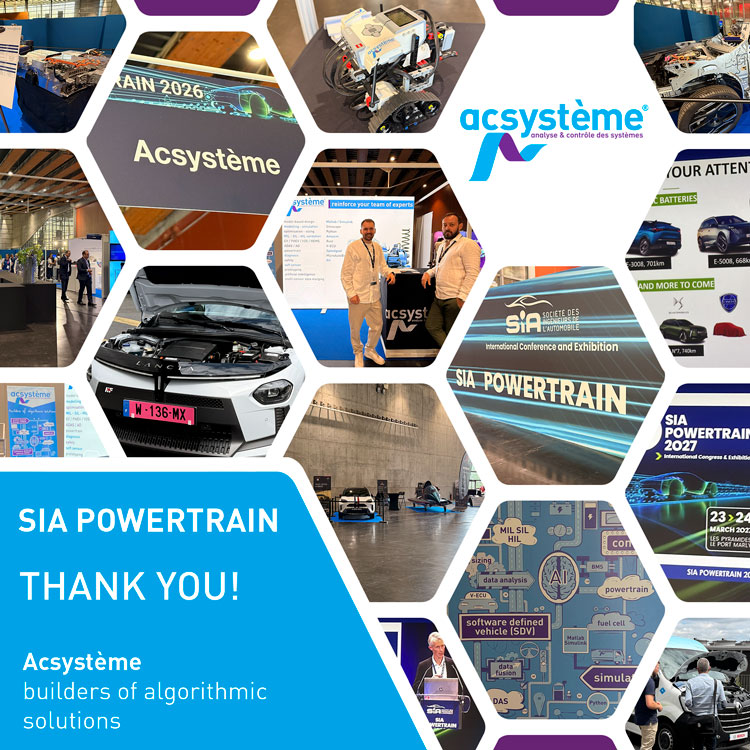

From 17 to 18 June in Lille, the Société des Ingénieurs de l’Automobile’s flagship event, SIA Powertrain 2026, took place. Acsystème was there; here’s a glimpse of the event.
The Acsystème team, comprising Guillaume Clavel, Nicolas Perigaud and Julien Jourdan, travelled to the 2026 edition of SIA Powertrain in Lille to run a stand and attend the numerous conferences and round-table discussions organised for the event. Here is the team’s report:
Day 1 Recap
- Opening panel (ACC / OPmobility / Stellantis / Valeo): The industry confirms that market evolution is leading to a diversification of powertrains. The energy transition will need to rely on several complementary technologies rather than a single solution.
- Luciano Rolando (Gamma Technologies): Comparison of different cabin heating architectures using Digital Twin. The simulations faithfully reproduce physical tests, demonstrating the maturity of modelling approaches to guide architectural choices.
- Jean-Marie Quelin (Ampere) – V-ECU / SIL industrialisation: Deployment of VEOS, dSPACE tools and a Renault software automation chain to accelerate SIL validations and create genuine synergies with HIL. An essential building block to achieve the target of reducing time-to-market to around two years, despite increasing complexity of architectures and embedded software. Many thanks to Jean-Marie and Alain for the quality of discussions during the exhibition and for sharing this highly structuring approach. The V-ECU is a fascinating topic on which we are pleased to support certain clients alongside dSPACE.
- Matthieu Plantier (Stellantis): Presentation of an innovative design approach enabling battery lifetime to be modelled through simulation by anticipating new usage patterns (mobility, V2X, etc.) and their impact on ageing.
- Martin Gleich (Infineon) – 750V Si/SiC: Comparison of power semiconductor technologies to optimise efficiency and losses in high-voltage architectures.
- Wendell DA (Valeo) – Next Generation On-Board Charger: Future on-board chargers will evolve towards single-stage architectures, removing the DC-Link to reduce cost, footprint and losses. Two approaches are being studied: modular and matrix-based.
- Jérôme Lachaize (Schaeffler): A highly complementary presentation to Valeo’s. Schaeffler favours a matrix-based architecture for an 11 kW charger. The control strategies are similar to those already used on DAB systems.
- Conclusion commune Valeo / Schaeffler: Future converters will move towards single-stage architectures that are more compact, more efficient and contain fewer components.
To conclude this first day, two major trends have emerged: simulation is becoming a key driver for industry (digital twins, V-ECUs, SIL, accelerated computing and the automation of validation processes to design and qualify increasingly complex systems more quickly), and power electronics continues to undergo a profound transformation.
DAY 2 RECAP
- Mathieu Da Graca (Phinia): Presentation of a diesel-to-hydrogen retrofit demonstrator. The main barriers are no longer technical feasibility but demonstrating system safety. Homologation was achieved after a full testing campaign (cold, hot and real-world operation).
- Maria Kalogirou (IAV): Development of highly detailed battery models followed by reduction into simplified models usable in vehicle simulations. Objective: maintain fidelity while reducing computation time.
- Cyril Marino (Groupe SERMA) : Current limitations of safety methodologies for next-generation batteries and the need to evolve analysis models.
- Francis Roy (Stellantis) & Thomas Peuchant (SAFT): Architecture integrating conversion functions directly into the battery, removing the DC/DC converter, with multi-chemistry compatibility and significant gains in weight, cost and efficiency.
- Alexander Fandakov (IAV): Optimisation of REEV architectures from a packaging and vehicle integration perspective
- Laurent Lafossas (Toyota Motor Europe): Carbon neutrality strategy based on the coexistence of BEVs, hybrids, e-fuels, biofuels and synthetic fuels depending on use cases and regions.
- Marianne Bataillon (Ampere): Multi-offer strategy from Ampere aimed at addressing several market segments with a range of powertrains
- Sophie Duzelier (Stellantis): Overview of Stellantis’ transition towards multi-energy platforms capable of integrating BEVs, hybrids and new architectures to adapt to market requirements.
- Jian Wu (Horse Powertrain): Chinese vision of the powertrain based on technological coexistence (BEV, hybrid, e-fuels, methanol, optimised ICE), driven by emissions targets rather than prescribed technologies.
- VIP Panel: Industry consensus: convergence towards a sustained coexistence of powertrains, with no single dominant technological scenario in the medium term.
This second day confirms that major strategic changes are underway in the automotive sector. All the presentations highlight a focus on optimising systems rather than on isolated breakthroughs, whether in the field of batteries, hybrid architectures or hydrogen engines. Two trends seem to have emerged from the talks:
- a high degree of functional integration (active battery architectures, multi-voltage platforms),
- technology safety (battery safety, hydrogen, thermal runaway, system validation).
As the 2026 edition of SIA Powertrain draws to a close, the industry is clearly witnessing a paradigm shift. The sector is gradually moving away from a ‘single-technology’ approach towards a multi-solution energy portfolio approach, tailored to specific use cases and regional constraints.