https://www.acsysteme.com/wp-content/uploads/2016/01/ressource-gridcode-750x499.jpg

Producing electricity in accordance with the Grid Code

Grid Code, standard for electrical networks

Published in 2016 by the European Commission, the grid code aims to standardize the electrical network standards, to homogenise the production and consumption of electricity in a country and between EU countries and strengthen the network stability. The grid code is divided into three categories: connection codes, market codes, and operating codes. This article focuses on the generator code (RfG), which is part of the connection codes.

Context

The arrival of renewable energies has been a breath of fresh air for the planet but has contributed to increase the complexity of our electrical networks. The number of producers has multiplied, as have small-scale installations. To maintain a stable power supply across the entire grid, the grid must be able to withstand significant load variations, such as the emergency shutdown of a wind farm during a strom, or a loss of sunlight over photovoltaic panels. Originally designed for wind power, the grid code for generators standard (NC RfG – Network Code on Requirements for Generators) has been extended to the new electricity producers (wind turbines, photovoltaic panels, generators, etc.), with retrictions adapted to the power output of the source. This standard categorises generators according to power levels: for each level, requirements specify the response of generators (resistance to voltage drops, recovery time, frequency variations, power levels, etc.).

https://www.acsysteme.com/wp-content/uploads/2026/03/RFG-commission-regulation-750×632.jpg

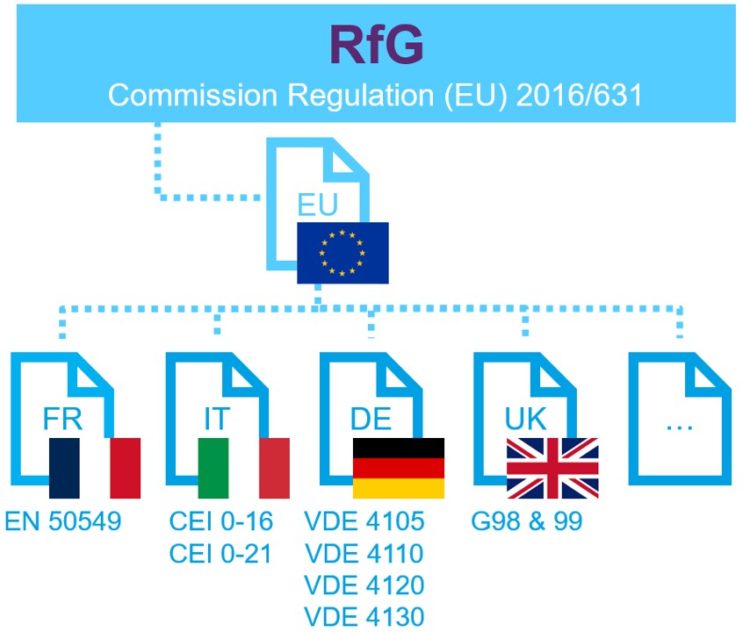
Overview of European grid codes for generating plants to be connected in parallel with distribution networks

Diversity of grid codes

In practical terms, this regulation should be transparent for the consumer, but from a production perspective, many adjustments to the European grid code are necessary to account for the different characteristics of each country’s electricity grid. The figure on the left shows the grid code references applicable to each country.

What is the grid code for ?

Remember the Spanish blackout of 2025? In Europe, it was the most significant outage since the Italian blackout in 2003. The ENTSO-E inverstigation identified the various events that led to the fast voltage increase and the cascade of disconnections of generators, leading to a major blackout. The report also defines several measures to strengthen the resilience of the electricity grid, in the form of recommendations concerning grid regulations.

The grid code for generators is precisely designed to contribute to the power supply stability. It specifices, among other things, voltage support strategies and protection mechanisms in case of faults, overvoltage or undervoltage.


Perpectives

Such incidents emphasize the crucial importance of deploying grid codes across all electricity generators. These specifications imply increasingly accurate and controllable systems, whose performance validation can be supported by modelling and simulation (see our article Grid code: simulation for certification). The challenge of grid stability has also led to the development of new technologies, such as smart grids, battery storage systems, AI, data analytics, and many others. The rise of electric vehicles, whose charging can be optimised based on grid data (smart charging), offers new opportunities through electricity storage, including the possibility of supplying power to the grid or buildings (vehicle-to-grid technogologies – V2X).

Arthur Roué, january 2016

Updated by Ophélie Rochette and Preeti Yadav, march 2026

Share this post: