

https://www.acsysteme.com/wp-content/uploads/2021/11/Formation-Acsysteme-750x501.jpg

icone_calendrier 24/11/2026 icone_position Nantes (44)

[Training] Introduction to Model-Based Design with MATLAB/Simulink and Arduino

In partnership with Smart Power, and drawing on over 20 years’ experience in this field, the experts at Acsystème offer training in model-based design.


The aim of the course is to explore the fundamental principles of model-based design (MBD) as applied to embedded systems. The first step will be to understand its benefits not only during the development phase but also for the simulation and validation of control systems. The key stages of MBD – namely modelling, simulation, implementation and validation – will be put into practice using Matlab/Simulink tools, as well as through prototyping on Arduino. Finally, the various validation methods – MIL, SIL and HIL – within an embedded development cycle will be presented.
Target audience

This course is aimed at engineers, technical managers, project managers, innovation managers and department heads who wish to learn about the principles of MBD and understand its benefits in the development of embedded systems.

It is also aimed at staff involved in control and command, automation, electronics, simulation, validation or embedded software development, who wish to gain an initial operational understanding of the MATLAB/Simulink tools and associated methodologies.

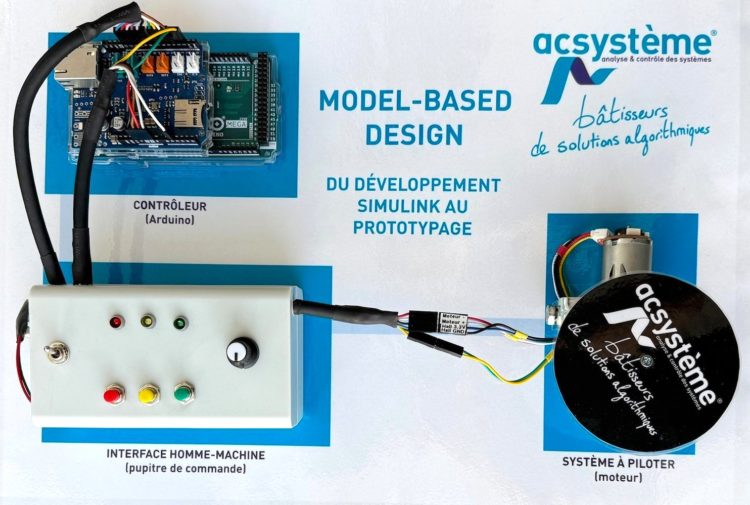
https://www.acsysteme.com/wp-content/uploads/2026/07/maquette-MBD-Arduino-Montage-750×505.jpeg
maquette MBD Arduino - Montage

prototyping on an Arduino board

Prerequisites

No prior knowledge of model-based design is required.

A general technical background in the fields of automation, electronics, electrical engineering or embedded systems is recommended to aid understanding of the examples and demonstrations presented during the course.

Training programme

9.00 – 9.30 am: welcome and introduction

  • Introduction of participants and round-table discussion
  • Gathering of expectations
  • Presentation of the training objectives and programme

9.30 – 10.30 am: Introduction to model-based design

  • History and origins of MBD
  • Industrial challenges and requirements
  • Position within the V-model
  • Links between MBD and MBSE
  • Advantages and benefits of the approach

10.30 – 10.45 am: Break

10.45 am – 12.30 pm: modelling concepts

  • definition and role of a model
  • different types of models
  • modelling and simulation environments
  • principles of model identification and validation

12.30 – 1.30 pm: lunch

1.30 – 3.30 pm: the main stages of MBD

  • system modelling
  • simulation and behaviour analysis
  • code generation and implementation
  • verification and validation: MIL, SIL, PIL, HIL

3.30 – 3.45 pm: break

3.45 – 4.30 pm: practical demonstration

  • Developing a control law for a winding system
  • Modelling based on functional requirements
  • MIL and then SIL simulation
  • Rapid prototyping on an Arduino board

4.30 – 5.00 pm : Conclusion and discussion

  • Summary of the concepts covered
  • Prospects for application in an industrial context
  • Q&A and discussion with participants

Teaching resources

  • Theoretical concepts illustrated with practical examples from the industrial sector
  • Interactive presentations and discussions with participants
  • Real-time demonstrations using Matlab/Simulink
  • A case study running throughout the course focusing on an embedded control system,
    hands-on implementation with prototyping on an Arduino board
  • Training materials provided to participants

Assessment criteria

  • To understand the trainees’ expectations and prior knowledge, a pre-training questionnaire must be completed and returned to Smart Power competitiveness cluster at least 7 days before the training course
  • To assess the relevance of the training course in relation to the trainees’ expectations, and as part of a process of continuous improvement, an evaluation and satisfaction questionnaire must be completed and returned to Smart Power at the end of the training course

Registration (Smart Power website)

Share this post: