Why is the EN 50549 standard essential?
Two-way charging not only allows an electric vehicle to be charged, but also enables energy to be fed back into the electricity grid.
This capability transforms the vehicle into a genuine electricity-generating unit. As such, additional regulatory requirements apply compared with a standard charging point. Whilst the ISO 15118 standard governs communication between the vehicle and the charging point, other regulations define the conditions under which a generator may feed energy back into the grid.
These requirements are harmonised at European level and then adapted by each country according to the specific characteristics of its electricity grid.
In our project, we have focused on the French version of the EN 50549 standard.
The aim of the project
Our client wanted to develop a V2G feature enabling its users to sell the energy stored in their vehicle’s battery back to the electricity grid.
In order to bring this solution to market, it was essential to obtain a certificate of compliance with the grid code – that is, the connection rules imposed on electricity generators.
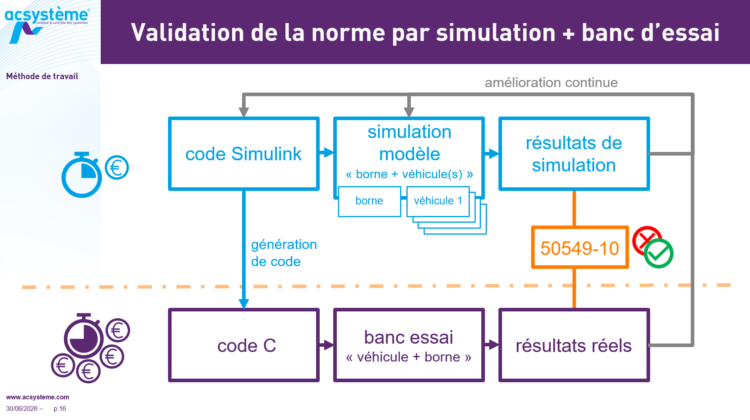
Acsystème was involved from the software specification phase right through to bench testing, supporting the client in obtaining this certification.
The two parts of the standard
In our case, the EN 50549 standard consists mainly of two parts:
- EN 50549-1, which describes the expected behaviour of generators connected to the low-voltage network,
- EN 50549-10, which defines the tests used to verify this compliance.
Part 1 covers small and medium-sized generation units, up to 1 MW. Although this is a significant power rating, an electric vehicle naturally falls into this category as a very small generation unit.
Example of a requirement: managing over-frequencies
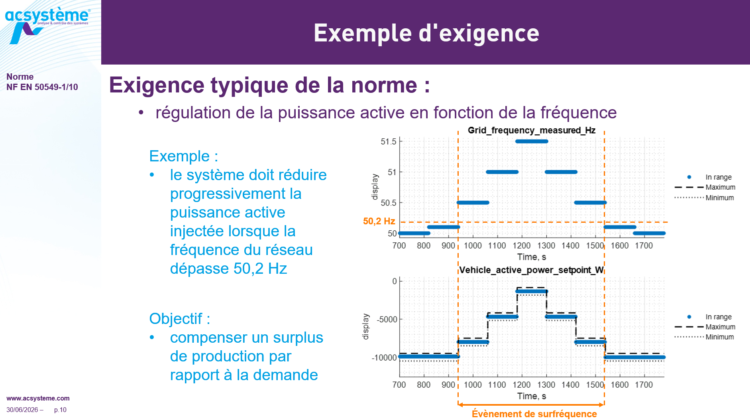
One of the requirements of the standard concerns the system’s response in the event of overfrequency.
The nominal frequency of the European grid is 50 Hz. When this exceeds 50.2 Hz, it generally indicates that electricity generation is exceeding consumption. In this situation, each generator must reduce the power it feeds into the grid in order to help stabilise the system.
During testing, it is therefore verified that an increase in frequency automatically leads to a reduction in the active power fed into the grid.